In This Article
A carbon steel chef knife that resists rust is a blade that keeps carbon’s keen, easy-to-sharpen edge while limiting the corrosion carbon steel is famous for. In practice, that means high-carbon stainless alloys, stainless-clad carbon cores, or a reactive blade you armor with patina and oil. Three routes, one goal.
Here’s the honest part most listicles skip: no steel is magic. Plain carbon steel will happily rust if you leave it wet overnight. But “rust-resistant” is a spectrum, and you can pick your spot on it. At one end sit forgiving stainless workhorses. At the other sits a blade that spends its life wearing a moody, blue-gray patina like a well-loved leather jacket.
I’d argue the right choice is less about steel snobbery and more about your habits. If you rinse and wipe a knife most nights, you have far more options than you think. If your knife regularly naps in a sink full of suds, you want a different shortlist.
This guide covers seven real, researched knives across budget, mid-range and premium tiers. It also explains high carbon steel hardness, patina formation, knife oil maintenance, and how to season a carbon steel chef knife with a care kit. Whether you’re shopping for a carbon steel chef knife for home cooks or just upgrading a tired block set, you’ll find a clear path below.
Quick Comparison: Best Carbon Steel Chef Knife That Resists Rust Picks at a Glance
| Knife | Steel & rust approach | Hardness (HRC) | Price range | Best For |
|---|---|---|---|---|
| Victorinox Fibrox Pro 8-Inch | X50CrMoV15 stainless | 56-58 | $35-$70 | Beginners, tight budgets |
| Mercer Culinary Millennia 8-Inch | High-carbon Japanese steel, marketed as low-maintenance | Not verified | Under $30 | First knives, shared kitchens |
| Misen 8-Inch Chef’s Knife | AUS-10 high-carbon stainless (verify current steel) | Not verified | $50-$80 | Value-minded home cooks |
| Tojiro DP Gyuto 210mm (F-808) | VG-10 core, stainless cladding | 59-61 | $100-$140 | Stepping into Japanese knives |
| MAC Professional MTH-80 | AUS8 stainless, sub-zero tempered | About 61 | $145-$195 | Light, nimble precision |
| Wüsthof Classic 8-Inch | X50CrMoV15 stainless, forged | 58 | $150-$180 | Heavy-duty daily prep |
| Hatsukokoro Kurokaze Shirogami #2 Gyuto | Carbon core, stainless cladding | 62-63 | $240-$270 | Carbon-steel enthusiasts |
Looking at the table, the Victorinox Fibrox Pro 8-Inch and Mercer Culinary Millennia 8-Inch win on sheer low-maintenance value, while the Tojiro DP Gyuto 210mm (F-808) and MAC Professional MTH-80 buy you noticeably harder steel without a rust penalty. The Hatsukokoro Kurokaze Shirogami #2 Gyuto is the only true carbon-core pick here, and its stainless cladding is what keeps it on a “resists rust” list at all. Prices are ranges at the time of research and may vary.
💬 Just one click — help others make better buying decisions too!😊
Top 7 Picks for a Carbon Steel Chef Knife That Resists Rust: Expert Analysis
1. Victorinox Fibrox Pro 8-Inch — the budget benchmark that shrugs off rust
Think of the Victorinox Fibrox Pro 8-Inch as the Honda Civic of chef’s knives. Unglamorous, relentlessly competent, almost impossible to regret. The blade is X50CrMoV15, a German stainless alloy whose chromium content is why it ignores a damp counter. Retailers list hardness around 56-58 HRC with an edge near 15 degrees per side.
On paper that’s soft by Japanese standards. In practice it means the blade forgives sloppy honing and re-sharpens in minutes, which is a gift to beginners. The stamped construction also keeps weight down, so your wrist tires later during a long prep session.
My take: this is the pick if you want the sharpness conversation without the rust conversation. Reviewers consistently praise the grippy handle and the value, and Cook’s Illustrated testing coverage keeps naming it a top inexpensive chef’s knife. A common complaint is that edge retention shows its budget roots, so expect to hone regularly.
Pros:
- ✅ Chromium-rich stainless means minimal rust worry
- ✅ Soft steel re-sharpens quickly at home
- ✅ Light stamped blade and non-slip handle
Cons:
- ❌ Edge retention trails harder steels
- ❌ Utilitarian look, no bolster
Price: roughly $35-$70 depending on retailer, so check current price. Value verdict: the best dollars-to-performance ratio here.
2. Mercer Culinary Millennia 8-Inch — cheapest way into a low-maintenance blade
If the Victorinox Fibrox Pro 8-Inch is the Civic, the Mercer Culinary Millennia 8-Inch (model M22608) is the reliable bicycle: gets you there for almost nothing. Listings describe a one-piece, high-carbon Japanese steel blade with a textured Santoprene handle.
Mercer doesn’t make hardness easy to find for this line. Sibling Mercer lines are reported near 53-54 HRC, so it’s reasonable to assume a soft, easy-to-sharpen blade rather than a long-lasting one. That’s inference, so verify on the listing. Softer steel also means faster touch-ups and a gentler learning curve, which suits a carbon steel chef knife for home cooks who are still building knife habits.
Verifiable review data is thinner here. The strongest signal I could confirm is that Cook’s Illustrated has given the Millennia a Best Buy designation. Beyond that, I’d rather tell you what’s unverified than invent a chorus of happy customers.
Pros:
- ✅ Remarkably low entry price
- ✅ Grippy handle suits wet hands
- ✅ Easy to sharpen and maintain
Cons:
- ❌ Likely softer, shorter-lived edge
- ❌ Hardness not clearly published
Price: typically under $30. Value verdict: a smart “starter” or backup knife.
3. Misen 8-Inch Chef’s Knife — sharp-out-of-the-box hybrid for the price
The Misen 8-Inch Chef’s Knife blends a German-leaning profile with Japanese-style steel. Amazon listings describe AUS-10 high-carbon stainless, while one review site notes a 2025 revision reportedly moving to AICHI ACUTO440. That’s worth checking on the exact listing you buy.
Why does that matter? High-carbon stainless like this gives you a sharper, harder edge than basic German stainless while still tolerating normal kitchen life. It’s a practical middle path for anyone who wants a carbon steel chef knife that resists rust without babysitting it.
Reviewer sentiment is generally positive but not unanimous. Reviewed.com tested a Misen knife set and rated it highly, and some owners say it’s dramatically better than their old supermarket knives. Other buyers report the harder Japanese-style steel can chip, and a few say the edge fades sooner than expected. Prudent Reviews also lists downsides to weigh before ordering.
Pros:
- ✅ Sharp factory edge for the money
- ✅ Hybrid profile feels familiar to most cooks
- ✅ High-carbon stainless limits rust risk
Cons:
- ❌ Some reports of chipping or edge fade
- ❌ Steel specification changed between versions
Price: around $50-$80. Value verdict: strong if you confirm the listing details.
4. Tojiro DP Gyuto 210mm (F-808) — Japanese hardness with stainless cladding
The Tojiro DP Gyuto 210mm (F-808) is the knife many people buy when they realize they want “more” than a German workhorse. A VG-10 core is sandwiched between rust-resistant stainless layers, hardened to roughly 59-61 HRC. Retailer specs suggest a fine edge in the 9-12 degree range.
Translation: it slices tomatoes and onions with almost eerie ease, and the cladding protects the flanks of the blade. The tradeoff is that thin, hard edges dislike bones, frozen food and twisting. Chefknivestogo describes it as a heavier middleweight by Japanese standards, yet still lighter than most Western equivalents.
One retail review says the buyer picked it up as a gateway blade and still uses it ten years later, which fits its reputation as a durable first Japanese knife. Cutlery and More lists a 4.5-out-of-5 average from a small review pool, so treat that as encouraging rather than definitive.
Pros:
- ✅ Hard VG-10 core holds a fine edge
- ✅ Stainless cladding adds rust protection
- ✅ Made in Japan at a mid-range price
Cons:
- ❌ Fine edge dislikes hard or frozen items
- ❌ Stock can run thin at some retailers
Price: around $100-$140. Value verdict: arguably the best “first Japanese knife” on this list.
5. MAC Professional MTH-80 — featherweight precision with rust-resistant steel
The MAC Professional MTH-80 is the knife people recommend with a conspiratorial grin. AUS8 stainless steel, sub-zero tempered, listed around 61 HRC with a 15 degree edge per side. It weighs roughly 6.8 ounces and has a 2.5mm spine. The dimples reduce food sticking.
That combination matters. A harder steel lets a thin blade keep its edge, and the light weight reduces fatigue. A carbon steel chef knife that resists rust and also feels like an extension of your hand is a rare combination, and this one delivers it.
Retailer reviews are glowing, with Cutlery and More showing a 4.9-out-of-5 rating from roughly 60 reviews, and the retailer lists accolades from Bon Appétit, Food & Wine and Wirecutter. Reviewers praise balance and sharpness. A cautionary note from buyers: treat it with respect, because a thin blade isn’t a prying tool.
Pros:
- ✅ Very light and nimble
- ✅ Hard steel with stain resistance
- ✅ 25-year warranty listed by retailers
Cons:
- ❌ Thin blade punishes twisting and prying
- ❌ Costs more than German stamped options
Price: around $145-$195. Value verdict: premium-feeling performance without carbon-steel chores.
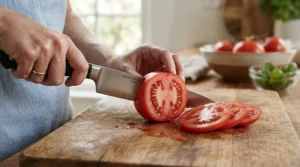
6. Wüsthof Classic 8-Inch — forged heft that tolerates rough handling
If the MAC Professional MTH-80 is a scalpel, the Wüsthof Classic 8-Inch is a trusty hammer with manners. It’s forged from X50CrMoV15 stainless, tempered to about 58 HRC, with PEtec edge technology producing roughly 14 degrees per side. Specs list about 9.2 ounces and a 3mm spine.
That mass is a feature if you chop through squash, carrots and the occasional chicken joint. It rocks smoothly and feels indestructible. For a carbon steel chef knife for home cooks who value durability over delicacy, it’s a classic for a reason.
Reviewers frequently describe it as a decades-long companion. One long-time owner noted the newer production felt slightly different from older Classics, a reminder that “iconic” doesn’t mean “frozen in time.” The full bolster can also complicate sharpening the heel of the blade, which is a common observation about this design.
Pros:
- ✅ Forged strength and satisfying heft
- ✅ 14-degree edge is sharp for a German knife
- ✅ Lifetime limited warranty
Cons:
- ❌ Heavier than Japanese-style alternatives
- ❌ Full bolster complicates heel sharpening
Price: around $150-$180. Value verdict: pricey, but built to be your last German knife.
7. Hatsukokoro Kurokaze Shirogami #2 Gyuto — true carbon steel with stainless armor
Now for the one that actually says “carbon steel” on the tin. The Hatsukokoro Kurokaze Shirogami #2 Gyuto has a Shirogami #2 carbon core, hardened to roughly 62-63 HRC, with stainless cladding and a rustic kurouchi finish. It’s an 8.25-inch gyuto with a bubinga handle.
Here’s why it still belongs on a list about a carbon steel chef knife that resists rust. The cladding covers the flanks, so only the cutting edge area is reactive. The retailer is upfront that this edge region will rust without care and will darken into a protective patina over time. You get carbon’s laser feel with a much smaller rust surface.
I’d be careful about over-promising here. Review data is almost nonexistent, with only one five-star retailer review, so I can’t summarize broader buyer sentiment. Availability also varies, so check current stock before you commit.
Pros:
- ✅ Shirogami core takes a ferocious edge
- ✅ Stainless cladding shrinks the rust surface
- ✅ Beautiful patina potential
Cons:
- ❌ Edge area still needs oiling and drying
- ❌ Very small verified review pool
Price: around $240-$270. Value verdict: for enthusiasts who want the carbon experience with training wheels.
✨ Don’t Miss These Top Picks!
🔍 Take your knife game to the next level with these carefully selected blades. Click on any highlighted item to check current pricing and availability. These tools will help you make the clean, confident cuts your family will notice at dinner!
How to Choose a Carbon Steel Chef Knife That Resists Rust
Choosing a carbon steel chef knife that resists rust comes down to seven decisions. Work through them in order and the shortlist writes itself.
- Decide your rust tolerance. Be honest. If you’ll wipe the blade every time, true carbon is fine. If not, choose stainless or stainless-clad.
- Check the steel name. Stainless steels contain more than about 12% chromium, which forms a protective layer. Names like X50CrMoV15, VG-10 and AUS-8 signal stainless behavior.
- Match hardness to your skill. Softer (55-58 HRC) steels forgive mistakes. Harder (60+) steels hold edges longer but chip more easily.
- Pick a profile. German-style knives rock and chop with heft. Japanese-style gyutos are flatter and lighter, favoring push-cuts.
- Look at edge geometry. A thinner blade and finer angle cut like a dream but demand gentler use.
- Budget for care. A few dollars of oil, a cloth and a rust eraser protect a much larger investment.
- Verify the listing. Steel and construction can change between versions, as the Misen 8-Inch Chef’s Knife shows.
In short: the best carbon steel chef knife that resists rust is the one whose maintenance requirements you’ll actually follow.
High Carbon Steel Hardness: What the Rockwell Numbers Really Mean
High carbon steel hardness is usually quoted on the Rockwell scale, typically the C variant (HRC). Higher numbers mean harder steel, which generally holds an edge longer but can be more brittle. Think of it like a pane of glass versus a sheet of plastic: one resists scratches, the other survives drops.
Western-style knives often sit around 55-58 HRC, while Japanese-style knives commonly run 60 and above. The Victorinox Fibrox Pro 8-Inch (about 56-58) and Wüsthof Classic 8-Inch (about 58) live at the forgiving end. The Tojiro DP Gyuto 210mm (F-808) (59-61) and MAC Professional MTH-80 (about 61) lean harder.
Carbon content drives much of this. In Japanese White Steel, for example, more carbon corresponds with higher hardness, from around 60 HRC at the lower-carbon end to about 63 at the top. High carbon steel hardness is exciting, but the number alone isn’t the story. Heat treatment, geometry and chromium content all shape real performance.
My practical rule: if you hone regularly and sharpen occasionally, 58-61 HRC is a sweet spot. Beyond that, you’re paying for extra edge life that matters most to heavy daily users.
Carbon Steel Chef Knife for Home Cooks: Who Should Actually Buy One
A carbon steel chef knife for home cooks is a lifestyle choice as much as a tool. The payoff is real: an edge that sharpens fast and feels crisp. The price is small habits, like wiping the blade between ingredients and drying it before storage.
That’s the key insight for any carbon steel chef knife for home cooks: the knife’s temperament has to match the household’s. A solo cook who likes ritual will probably love a patina-building blade. A busy household where knives get tossed in a sink may be happier with the Victorinox Fibrox Pro 8-Inch or Wüsthof Classic 8-Inch.
One knife-sharpening expert cited by Gear Patrol says that if wiping a blade or a bit of rust bothers you, you probably shouldn’t buy carbon steel. That’s blunt, but it’s good advice.
Beginners usually thrive with forgiving stainless first. Intermediate cooks who crave a sharper experience can step up to the Tojiro DP Gyuto 210mm (F-808). And once you’re comfortable, a stainless-clad carbon blade like the Hatsukokoro Kurokaze Shirogami #2 Gyuto is a gentle bridge into the true carbon world.
Patina Formation: How Your Blade Armors Itself
Patina formation is the natural darkening of carbon steel as it reacts with air, moisture and food. It’s a thin oxide layer that can look gray, blue, brown or even purple. Orange, rough or powdery spots are different: that’s rust, and it needs to be removed.
Here’s the useful part. Patina formation changes how reactive the blade is, and America’s Test Kitchen has explained why a patina matters for protection as well as looks. Using the knife regularly, wiping it dry as you work, and rinsing and drying afterward all encourage a stable layer.
What you cut changes the colors. Proteins tend to push blue and green tones, while vegetables lean gray and brown. Acidic foods speed patina formation, and some owners force it with mustard or vinegar. Knifewear cautions that this permanently alters the finish and can even remove a kurouchi coating, so skip it if you love the blade’s original look.
One nuance worth keeping: patina slows corrosion but doesn’t make steel immune. You still need to wash and dry the knife properly.
How to Season Carbon Steel Chef Knife Care Kit Essentials, Step by Step
Here’s how to season a carbon steel chef knife with a care kit, in a way that sets up good habits from day one.
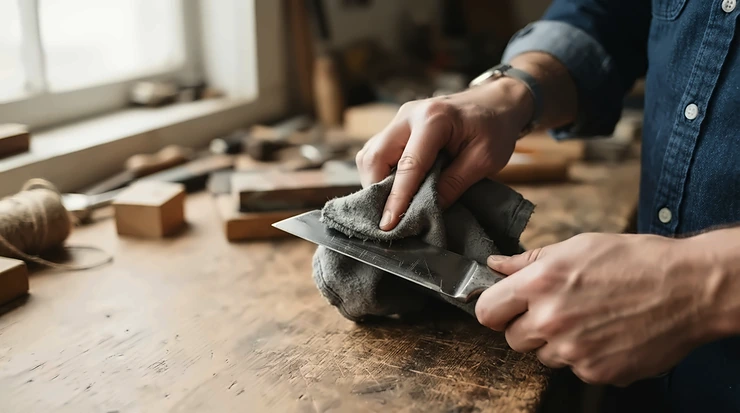
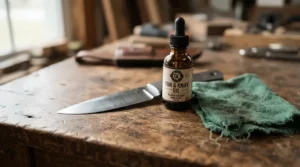
What belongs in the kit: food-safe mineral or camellia oil, a lint-free cloth, a rust eraser or Bar Keepers Friend for light spots, and a dry sheath or saya.
The routine:
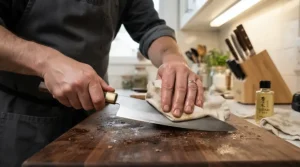
- Wash off factory residue. Use warm water and a drop of dish soap, then dry completely.
- Choose your path. Let patina formation happen naturally, or force it with a mustard or vinegar soak (rinse and dry after).
- Oil the blade. Apply a thin film with the cloth, then wipe off the excess.
- Start gently. Cut low-acid foods first, wiping the blade between ingredients.
- Dry, then store. If you use a saya, make sure both knife and sheath are fully dry, because a damp sheath is a common rust culprit.
This same routine works for a stainless-clad carbon blade like the Hatsukokoro Kurokaze Shirogami #2 Gyuto. For stainless options such as the MAC Professional MTH-80, the how to season carbon steel chef knife care kit routine is optional but still nice for longevity. Never use the dishwasher on a carbon blade.
Knife Oil Maintenance: A Weekly Routine That Keeps Rust Away
Knife oil maintenance is the quiet hero behind every shiny carbon steel chef knife that resists rust. A thin barrier of oil keeps moisture away from the steel while still letting patina develop.
Knifewear’s carbon steel care guide suggests applying a few drops weekly during the first few months. I’d extend that into a simple schedule:
- After every wash: dry thoroughly. Oil only if the blade will rest more than a day.
- Weeks 1-12: apply a light coat weekly.
- After that: oil monthly, or any time you spot dull, dry-looking patches.
Choose a food-safe oil. Mineral oil is widely recommended, and camellia (Tsubaki) oil is a traditional Japanese option. One Australian retailer even suggests mineral oil as a stand-in when camellia isn’t stocked.
Knife oil maintenance takes about thirty seconds. A tiny investment protects a Tojiro DP Gyuto 210mm (F-808) or a Wüsthof Classic 8-Inch just as well as a reactive blade, especially if you live somewhere humid.
Problem → Solution Guide: Rust Spots, Stains and Metallic Taste
Problem 1: Orange spots appeared overnight.
That’s light rust. Use Bar Keepers Friend or a rust eraser, rub gently, rinse, dry and oil. Don’t panic: it’s a normal part of owning reactive steel.
Problem 2: The blade is turning gray and blue.
Good news, that’s patina. Leave it alone. If it bothers you, don’t scrub; polishing it off just resets the process.
Problem 3: Fruit tastes slightly metallic.
Reactive blades can react with acidic foods, and some cooks prefer stainless knives for fruit. The Victorinox Fibrox Pro 8-Inch or Misen 8-Inch Chef’s Knife are easier choices for citrus-heavy prep.
Problem 4: Rust keeps coming back in the sheath.
Check that both blade and sheath are fully dry before storage. Persistent trouble usually points to a damp sheath or skipped oiling.
Problem 5: Rough pits under the discoloration.
That suggests longer neglect. Remove surface rust, then re-establish a routine. Deep pitting may need professional sharpening or restoration.
Real-World Scenarios: Matching a Knife to Your Kitchen
Scenario 1: The student with a tiny budget. You cook four nights a week, share a sink, and wash fast. The Mercer Culinary Millennia 8-Inch or Victorinox Fibrox Pro 8-Inch gives sharp performance for a small outlay, with minimal rust anxiety.
Scenario 2: The busy family cook. You prep a big weeknight dinner five days a week with a mid-range budget. The Wüsthof Classic 8-Inch handles squash, roasts and rushed cleanup, while the MAC Professional MTH-80 suits someone who values light precision.
Scenario 3: The enthusiast. You love ritual, tolerate patina, and want the carbon experience. Pair the Hatsukokoro Kurokaze Shirogami #2 Gyuto with a care kit and a weekly oil habit. You’ll be cutting with something special without exposing the whole blade to rust.
Scenario 4: The curious upgrader. You’ve outgrown a block set but fear commitment. The Tojiro DP Gyuto 210mm (F-808) is a measured step up, and the Misen 8-Inch Chef’s Knife is a cost-conscious alternative.
Carbon Steel vs Stainless Steel: A Written Comparison
| Factor | Full carbon steel | Stainless-clad carbon | High-carbon stainless |
|---|---|---|---|
| Rust risk | Highest | Moderate (edge area) | Lowest |
| Sharpening feel | Very easy | Easy | Moderate |
| Maintenance | Wipe, dry, oil | Wipe, dry, oil edge | Basic care |
| Example | Reactive Japanese carbon blades | Hatsukokoro Kurokaze Shirogami #2 Gyuto | Victorinox Fibrox Pro 8-Inch, Wüsthof Classic 8-Inch |
| Best For | Dedicated enthusiasts | Curious carbon fans | Busy home cooks |
The table shows why “carbon steel” is a spectrum, not a switch. Stainless-clad blades like the Hatsukokoro Kurokaze Shirogami #2 Gyuto reduce exposed carbon, while stainless blades like the Victorinox Fibrox Pro 8-Inch remove most of the chore. The tradeoff is feel: full carbon tends to sharpen faster and feel crisper.
Carbon takes the sharpest edge and sharpens back up fast, but it reacts to air, moisture and acid. If you like gadgets that “just work,” go stainless. If you like a knife with personality, go carbon or clad.
Features That Actually Matter (And Those That Don’t)
Matter:
- Steel plus heat treatment. Hardness only helps if the steel and geometry support it.
- Edge angle and thickness. The MAC Professional MTH-80 and Tojiro DP Gyuto 210mm (F-808) feel sharp because their geometry is thin.
- Balance and handle comfort. The best knife is the one your hand forgets it’s holding.
- Warranty. Both Wüsthof Classic 8-Inch and MAC Professional MTH-80 list long warranties.
Don’t matter as much:
- Fancy Damascus patterns. They’re pretty, but pattern isn’t performance.
- “Surgical” marketing language. It rarely correlates with real cutting behavior.
- Hardness alone. A knife at 62 HRC isn’t automatically better for you than one at 58.
- Brand mystique. The Victorinox Fibrox Pro 8-Inch beats plenty of pricier names in value.
Strip away the hype and a carbon steel chef knife that resists rust is really about balance: sharpness, forgiveness and upkeep.
Long-Term Cost & Maintenance: Total Ownership at a Glance
| Knife | Upfront range | Care effort | Edge upkeep | Value logic |
|---|---|---|---|---|
| Victorinox Fibrox Pro 8-Inch | $35-$70 | Low | Frequent honing | Cheapest per year |
| Mercer Culinary Millennia 8-Inch | Under $30 | Low | Frequent honing | Low risk starter |
| Tojiro DP Gyuto 210mm (F-808) | $100-$140 | Low-moderate | Occasional stones | Strong performance per dollar |
| MAC Professional MTH-80 | $145-$195 | Low-moderate | Occasional stones | Premium feel, long life |
| Hatsukokoro Kurokaze Shirogami #2 Gyuto | $240-$270 | Moderate | Oil and patina care | Enthusiast pleasure |
Best For: Victorinox Fibrox Pro 8-Inch and Mercer Culinary Millennia 8-Inch for lowest annual cost; Hatsukokoro Kurokaze Shirogami #2 Gyuto for those who value ritual.
Total cost of ownership is mostly about longevity. A knife in the $150 range kept for fifteen years averages around $10 a year before sharpening. The Mercer Culinary Millennia 8-Inch wins on upfront cost, but replacing it sooner could erase that advantage. Care supplies like oil and a rust eraser typically cost a small fraction of the knife itself.
FAQ
❓ Which carbon steel chef knife that resists rust is best under $100?
❓ Can I put a carbon steel chef knife in the dishwasher?
❓ What is the best oil for knife oil maintenance?
❓ Is a harder blade above 60 HRC better for beginners?
❓ How long does patina take to develop on a new blade?
Conclusion
Choosing a carbon steel chef knife that resists rust isn’t about finding a miracle alloy. It’s about matching the steel’s personality to your habits. If you want simple and forgiving, the Victorinox Fibrox Pro 8-Inch, Mercer Culinary Millennia 8-Inch and Misen 8-Inch Chef’s Knife are sensible starting points. If you want harder steel without the chores, the Tojiro DP Gyuto 210mm (F-808), MAC Professional MTH-80 and Wüsthof Classic 8-Inch all deliver. And if you want the full carbon experience with a safety net, the Hatsukokoro Kurokaze Shirogami #2 Gyuto is a thoughtful bridge.
Whatever you pick, a few habits do the heavy lifting: wash by hand, dry right away, oil when needed, and let patina formation do its quiet work. A carbon steel chef knife for home cooks should make dinner more fun, not feel like a second job.
Take another look at the quick comparison table, choose the knife that fits your routine, and check current pricing before you buy. Your future self, mid-onion, will be grateful.
Recommended for You
- [Add your blog post link 1]
- [Add your blog post link 2]
- [Add your blog post link 3]
Disclaimer: This article contains affiliate links. As an Amazon Associate, I earn from qualifying purchases. If you purchase products through these links, we may earn a small commission at no additional cost to you.
✨ Found this helpful? Share it with your friends! 💬🤗
