
In This Article
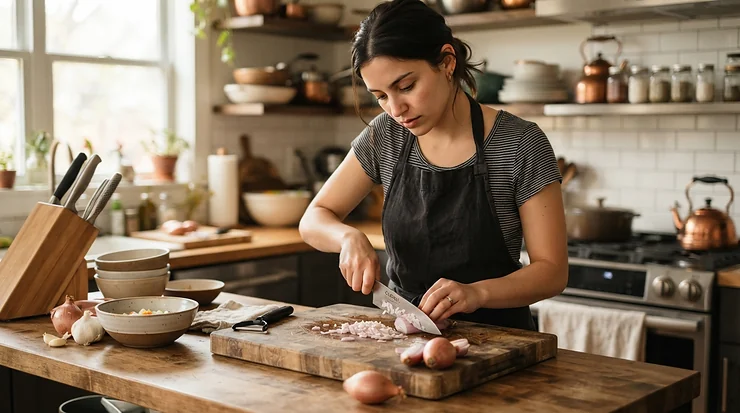
A left handed chef knife for lefty home cooks is an all-purpose kitchen knife with either a true left-side bevel and mirrored handle or, more commonly, a symmetrical double-bevel edge and a handle that feels natural in the left hand. The goal: straight, effortless cuts without fighting the blade.
Lefties are a minority in the kitchen, as everywhere. Wikipedia’s overview of handedness notes that roughly 90 to 93 percent of adults are right-handed, which explains why so much cutlery is quietly designed with righties in mind. A slightly off-angle handle here, a bevel that nudges the blade sideways there, and suddenly dicing an onion feels like steering a shopping cart with one bad wheel.
Here’s the good news, and it surprised me when I dug into the research: most lefties don’t need a special knife at all. They need the right kind of knife. A symmetrical edge grind and a smooth, uncomplicated handle will serve a southpaw beautifully. A handful of true left-handed models exist for cooks who want a mirror image. This guide sorts the two camps, compares seven real options from budget to premium, and walks through the bevel, grip, and sharpening details that spec sheets skip.
One note on method. I haven’t carved a thousand onions with these blades. Everything below is built from manufacturer specs, retailer data, and the aggregated sentiment of real reviewers, then filtered through plain-English analysis. Prices are ranges because they move constantly, so check current pricing before you buy.
Quick Comparison: 7 Left Handed Chef Knife Picks at a Glance
| Knife | Edge Type | Handle Style | Approx. Weight | Price Range | Best For |
|---|---|---|---|---|---|
| Lefty’s Left Handed Chef Knife | True left bevel (verify listing) | Molded plastic, left-oriented | ~4 oz | Around $20 | Tight budgets, curious beginners |
| Mercer Culinary Millennia M22608 | Symmetrical double bevel | Santoprene/polypropylene, finger guard | ~6.7 oz | Under $30 | Students, wet-hand grip |
| Victorinox Fibrox Pro 8-Inch | Symmetrical double bevel | Textured Fibrox | ~5.8 oz | $40–$65 | Best all-round value |
| Tojiro DP Gyuto 210mm | Symmetrical, VG-10 core | Western, ambidextrous | ~7 oz | $100–$140 | First Japanese knife |
| Global G-2 | Symmetrical, 15° each side | All-steel, dimpled | ~6–8 oz | $100–$200 | Slim-grip, low-maintenance fans |
| MAC MTH-80 | Double bevel, ~15° each side | PakkaWood | ~7 oz | $150–$175 | Thin-slice precision |
| Shun Classic Left-Handed 8-Inch | 16° each side | Left-oriented D-shape | ~7.4 oz | $190–$250 | Lefties wanting a mirrored handle |
Looking at the table, the Victorinox Fibrox Pro 8-Inch and Mercer Culinary Millennia M22608 deliver the best value for anyone just starting out, while the Tojiro DP Gyuto 210mm is the smartest step up into Japanese steel. Only two knives here are genuinely left-handed by design, Lefty’s Left Handed Chef Knife and the Shun Classic Left-Handed 8-Inch. The other five rely on symmetry, which is exactly why they work in either hand. If a mirrored handle matters to you, the field narrows fast; if it doesn’t, the Global G-2 and MAC MTH-80 justify their extra cost on edge quality alone.
💬 Just one click — help others make better buying decisions too!😊
Top 7 Left Handed Chef Knife Picks for Lefty Home Cooks: Expert Analysis
1. Lefty’s Left Handed Chef Knife — true left-side bevel on a tiny budget
Most knives treat lefties as an afterthought; this one is built around them. Roundups describe a bevel ground for a left-handed cutting stroke, so the edge shouldn’t drift off your line of cut.
The 7.5-inch blade is a touch shorter than the standard 8-inch, which is friendlier on small boards and for cooks with smaller hands. At roughly 4 ounces with a molded plastic handle, it’s feather-light. That’s great for fatigue, less great for dense butternut squash, where heavier blades do more of the work for you.
Think of it as the experiment knife. It lets you feel what a mirror-image edge does without committing real money. One caution from the research: roundup descriptions disagree on the edge, with at least one calling it serrated on the left side, so confirm the listing details before you click buy.
Reviewers in those roundups praise the genuine left-handed bevel and the light weight. The review pool is small, though, just a couple dozen ratings in one snapshot. Treat the praise as promising rather than proven, since long-term edge retention is largely unreported.
Pros:
- ✅ True left-handed bevel at a bargain
- ✅ Very light, easy on tired wrists
- ✅ Shorter blade suits smaller boards
Cons:
- ❌ Small review pool, thin track record
- ❌ Plastic handle and light blade lack heft
Expect around $20. As a low-risk way to try a left-ground edge, that’s a fair deal; as a decade-long workhorse, probably not.
2. Mercer Culinary Millennia M22608 — grippy handle that forgives wet hands
This is the knife restaurant kitchens hand to new hires, and there’s a reason. The Santoprene-and-polypropylene handle has textured finger points and a protective guard, so your hand stays put even when things get slippery.
The stamped, high-carbon Japanese steel blade runs 8 inches and weighs about 6.7 ounces. In practice that means quick, nimble prep and easy sharpening, though you won’t get the forged heft that helps rock through hard vegetables. The handle’s symmetrical shape has no left-or-right hump, which is why lefties adapt to it quickly.
My analytical take: it’s the best chef knife for left handed beginners who aren’t sure they’ll stick with cooking. You can learn grip and technique on it, and if you later graduate to something fancier, it stays useful as a backup. The finger guard is a quiet safety win for nervous first-timers.
Aggregated review sentiment is strong. Retailer-mirrored listings show several thousand ratings averaging in the high 4s, and working cooks repeatedly mention the sharp edge, light feel, and low price. One reviewer found the 8-inch size a bit bulky for casual use, which is worth weighing if you have small hands.
Pros:
- ✅ Non-slip handle with finger guard
- ✅ Sharp, easy-to-maintain steel
- ✅ Huge, consistent review base
Cons:
- ❌ Stamped blade feels lightweight
- ❌ Not dishwasher-safe per listings
Pricing typically lands under $30, which makes the value verdict easy: outstanding for the money.
3. Victorinox Fibrox Pro 8-Inch — the test-kitchen workhorse
If you buy one knife and never think about it again, this is the most defensible choice. America’s Test Kitchen family publications describe it as the knife their own test kitchen reaches for all day, every day.
The numbers explain the appeal. It weighs about 5.8 ounces, with a 2.3mm spine and a 5.5-inch handle. The tip sits at the centerline for easy rocking, and the flat spine gives you something to press on for tough skins. The textured Fibrox handle is symmetrical and NSF-certified, so a left hand finds no awkward ridge to fight.
Here’s what the spec sheet won’t tell you: the thin, stamped blade means this knife rewards technique over brute force. Reviewers consistently report razor-sharp out-of-box performance and a secure grip, including when wet. A recurring complaint is that it lacks the commanding heft of forged, full-tang knives.
For lefty home cooks, this is the safe, boring, brilliant pick. It’s also an easy way to try a chef knife for left handed beginners without buying a single thing labeled “lefty.”
Pros:
- ✅ Sharp straight out of the box
- ✅ Secure, symmetrical textured handle
- ✅ Lifetime warranty against defects
Cons:
- ❌ Lighter, less substantial feel than forged knives
- ❌ Handle looks utilitarian, not pretty
Expect roughly $40–$65. Value verdict: arguably the best price-to-performance ratio on this list.
4. Tojiro DP Gyuto 210mm — a gateway Japanese blade without the sticker shock
A gyuto is simply the Japanese chef knife, and this one is among the most beloved entry points. A VG-10 steel core is clad in softer stainless, which keeps sharpening manageable while delivering a keener edge than most Western-style budget blades.
At 210mm (about 8.3 inches) and roughly 7 ounces, it’s lighter than a German forged knife but more substantial than a stamped blade. Retailers list it as a double-bevel design, so it works for either hand, and one roundup notes the Western handle is ambidextrous. That’s the real draw for lefties: Japanese sharpness without the single-bevel learning curve.
The honest analysis: its thinner edge is less forgiving of twisting or bone contact than a German-style knife. Treat it as a slicing and chopping specialist, not a cleaver. Reviewers at one specialty retailer call it great bang for the buck, and one owner says they bought it as a gateway blade and still use it years later. Another noted sharp corners on the spine and choil that could use rounding, which is a quick fix on a stone.
Pros:
- ✅ VG-10 core takes a fine edge
- ✅ Double bevel works for either hand
- ✅ Long track record among enthusiasts
Cons:
- ❌ Spine and choil corners can feel sharp
- ❌ Thin edge less forgiving of abuse
Around $100–$140 is the going range. Verdict: excellent value for cooks ready to graduate from stamped steel.
5. Global G-2 — seamless all-steel build with a razor 15° edge
Global’s signature look is more than style. The handle is hollow and sand-filled for balance, with no bolster and a built-in finger notch, so the entire knife is a single smooth silhouette.
The edge is ground to an acute 15 degrees on both sides, with CROMOVA 18 steel hardened to roughly 56–58 HRC. In practice, that symmetrical edge grind slices tomatoes and herbs cleanly in either hand, and the all-steel handle has no left or right orientation at all. Weight varies by source, roughly 6 to 8 ounces, but it feels nose-light and nimble either way.
Here’s the catch. Reviewer opinion splits sharply. Some adore the thin handle; others report it slick with wet hands or awkward to hold, particularly with a full-palm grip. The practical test: if you pinch-grip the blade at the bolster-less heel, you’ll likely love it. If you hold a knife like a hammer, try before you buy.
Pros:
- ✅ Genuinely ambidextrous all-steel design
- ✅ Acute 15° symmetrical edge
- ✅ Hygienic, seamless handle
Cons:
- ❌ Metal handle can feel slippery when wet
- ❌ Hand wash only, thin edge needs care
Prices run roughly $100–$200 depending on seller and promotion. Verdict: worth it if the grip suits you, a poor bet if it doesn’t.

6. MAC MTH-80 — thin 2.5mm blade that glides through produce
Wirecutter has named this its top chef’s knife pick since 2013, and Bon Appétit and Food & Wine have also crowned it. That’s a long run of consensus for a single knife.
The spec sheet reads like a speed run: 2.5mm spine, Rockwell hardness around 60, dimples to reduce sticking, and a PakkaWood handle. Retailer listings describe a double-bevel edge at about 15 degrees per side with a 25-year warranty, and one Dutch retailer lists it for both right- and left-hand use. Weight sits around 7 ounces, so it’s agile without feeling flimsy.
A caution for lefties: one reviewer described the profile as a hybrid between a Japanese single bevel and a Western V-edge. Because “symmetrical” matters so much to left-handers, inspect the factory edge when it arrives and confirm both sides look equal. Also, retailers warn about counterfeit MTH-80s, so buy from authorized sellers.
Reviewers consistently describe it as very sharp out of the box and comfortably light. The thin blade is less forgiving with hard squash or frozen foods, which is the price of that glide.
Pros:
- ✅ Long-running critic favorite for home use
- ✅ Thin blade slices with minimal drag
- ✅ 25-year warranty from the maker
Cons:
- ❌ Thin blade dislikes hard or frozen foods
- ❌ Counterfeits circulate, so buy carefully
Expect roughly $150–$175. Verdict: excellent if slicing finesse is your priority.
7. Shun Classic Left-Handed 8-Inch — a mirrored D-shaped handle made for the left hand
This is the knife for lefties who want the full custom experience. Shun’s standard Classic uses a D-shaped handle with a ridge positioned for right-handed grips; the left-handed version flips it, along with an asymmetrical bolster for a secure fit.
The blade is a VG-MAX core with Damascus-style cladding, ground to 16 degrees per side, with a pakkawood handle and a limited lifetime warranty. At roughly 209 grams (about 7.4 ounces), the weight sits comfortably forward. In plain terms: the handle contour hugs the left hand instead of fighting it, and the edge is thin and keen.
One retail reviewer who also considered a MAC said the left-handed handle felt perfect and was small enough for people with smaller hands. That’s anecdotal, but it matches the design logic.
My analytical take: this is the “buy once, cry once” pick for lefties. It costs more than anything else here, and the left-handed version is harder to source than standard Shuns, so check availability before committing.
Pros:
- ✅ Handle truly shaped for the left hand
- ✅ Keen 16° edge with Damascus-style looks
- ✅ Limited lifetime warranty from the brand
Cons:
- ❌ Highest price of the seven
- ❌ Harder VG-MAX edge can chip if mistreated
Expect roughly $190–$250. Verdict: pricey, but the only mainstream premium knife with a mirrored handle.
✨ Don’t Miss These Exclusive Deals!
🔍 Take your home cooking to the next level with these carefully selected knives. Click on any highlighted product to check current pricing and availability. These tools will help you create effortless, precise cuts your whole family will notice!
Real-World Scenarios: Matching a Knife to Your Kitchen
Specs only matter once they meet a real kitchen. Here are three hypothetical profiles, with the reasoning behind each match.
Scenario one: the shared-apartment student. Budget is $30, the knife will be washed by roommates, and cutting boards are scratched plastic. The Mercer Culinary Millennia M22608 wins on grip, low cost, and tolerance for abuse. If a bit more is available, the Victorinox Fibrox Pro 8-Inch edges ahead on out-of-box sharpness and the long-running testing record behind it.
Scenario two: the Sunday meal-prepper. She chops four pounds of vegetables every weekend, has smaller hands, and has a budget near $200. The Shun Classic Left-Handed 8-Inch makes sense, because the mirrored handle matters most during long sessions. If she prefers a lighter, thinner feel, the MAC MTH-80 is the alternative.
Scenario three: the upgrader. He’s outgrown a supermarket block set and wants a real step up for under $150. The Tojiro DP Gyuto 210mm is the move: Japanese steel, double bevel, no special handling needed.
A few patterns hold across all three. Budget buyers should prioritize grip and symmetry over steel prestige. Mid-range buyers get the biggest improvement from a thinner, harder edge. Premium buyers should buy the handle first and the steel second, because a knife you hate holding sits in a drawer.
Your First 30 Days: A Left-Handed Setup and Sharpening Guide
A new knife deserves a deliberate first month. Here’s a practical sequence that works for any of the seven picks.
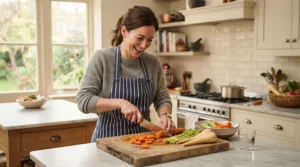
Week one: inspect and test. Look straight down the edge. Both bevel faces should look equal in width and polish, which is the quickest check that you actually received a symmetrical edge grind. Then slice a ripe tomato; a sharp knife should glide with almost no pressure.
Week one: find your grip. Pinch the blade just ahead of the handle with thumb and forefinger, then wrap the other fingers around the handle. Your right hand holds the food in a claw shape, knuckles guiding the flat of the blade. Practice slowly; speed comes later.
Weeks two and three: build rhythm. Start with onions and carrots, which teach most basic cuts. Keep the tip on the board and rock smoothly.
Week four: maintain. Hone lightly every few uses and plan a whetstone session every few months, depending on how often you cook. For Japanese-style knives like the Global G-2, Tojiro DP Gyuto 210mm, MAC MTH-80, and Shun Classic Left-Handed 8-Inch, aim for roughly 15–16 degrees per side. Western-style edges generally sit steeper, around 20 degrees. Whatever you choose, keep the same angle on both faces so the edge stays symmetrical.
Common first-month mistakes: scraping food off the board with the blade edge (use the spine), washing in the dishwasher, and storing loose in a drawer where the edge bangs around.
Single Bevel vs Double Bevel Left Handed Chef Knife: Which Should You Buy?
This is the question that trips up most lefties, so let’s make it simple. A double bevel is sharpened on both faces of the blade. A single bevel (also called a chisel grind) is sharpened on one face only, like a wood chisel.
That matters for handedness because a single-bevel knife is either right- or left-handed. Retail guides note that most are made right-handed by default, and left-handed versions are harder to find. A left-handed cook in the Knifewear shop wrote a practical guide to finding a left-handed knife, noting that single-bevel options for lefties exist but are less common, and that handle comfort and sharpening are customers’ biggest worries.
| Feature | Double Bevel | Single Bevel (left-handed) |
|---|---|---|
| Works for lefties out of the box | Yes | Only if ground for the left hand |
| Sharpening difficulty | Easier | Needs practice |
| Best tasks | All-purpose chopping and slicing | Sashimi, delicate vegetable work |
| Availability | Widely available | Scarce, often special order |
| Best For | Beginners and everyday cooking | Experienced cooks of Japanese technique |
The takeaway is plain: for a single bevel vs double bevel left handed chef knife decision, double bevel wins for nearly every home cook. The Victorinox Fibrox Pro 8-Inch, Tojiro DP Gyuto 210mm, and MAC MTH-80 all deliver sharp, symmetrical edges that work in either hand. Single-bevel gyutos are described by specialty retailers as extremely rare, so unless you’re cooking traditional Japanese cuisine, you’re not missing much. If you’re curious, the Lefty’s Left Handed Chef Knife is the cheapest way to try a left-ground edge.
Chef Knife for Left Handed Beginners: Start Here
Choosing a chef knife for left handed beginners comes down to three priorities: forgiveness, grip, and low regret.
Forgiveness means a thicker or sturdier blade that survives mistakes. The Mercer Culinary Millennia M22608 is a great fit, with its finger guard and slip-resistant handle. Grip means a symmetrical, textured handle with no orientation, such as the Victorinox Fibrox Pro 8-Inch. Low regret means a price you won’t agonize over, which is why neither of those costs more than $65.
The mistakes beginners make, in order of frequency: buying a single-bevel knife because it “looks professional,” choosing ultra-thin premium steel before learning to keep an edge, and skipping a cutting board that holds the food steady. A chef knife for left handed beginners should feel boring in the best way. If you notice the knife less than the food, it’s working.
When you’re ready to level up, the Tojiro DP Gyuto 210mm is a gentle bridge into Japanese steel. For a lefty-specific indulgence later, the Shun Classic Left-Handed 8-Inch is the destination. Start simple, sharpen regularly, and let your hands tell you what to upgrade.
Symmetrical Edge Grind: Why It’s the Lefty’s Secret Weapon
Why does a symmetrical edge grind matter so much? Because it means the knife treats your left and right sides equally. Equal bevel angles on both faces keep the blade tracking straight through food, regardless of which hand holds the handle.
Not every “double bevel” is perfectly equal. Retail experts at a specialty shop note that some knives are ground with slight asymmetry. They say these knives rarely steer in use, but the issue concerns left-handed customers and anyone sharpening them, because an uneven grind is easy to maintain wrongly. That’s why the quick edge inspection in your first week matters.
Among our picks, the Global G-2 is the clearest example of a symmetrical edge grind, with a stated 15 degrees on both sides. The Shun Classic Left-Handed 8-Inch lists 16 degrees per side, and the MAC MTH-80 is described at about 15 degrees per side. A symmetrical edge grind also makes sharpening forgiving: you work both faces the same way, with no special left-handed technique.
How to verify one yourself: hold the knife edge-up under bright light and look along the blade. Both bevels should appear the same width. If one side looks noticeably wider, contact the seller before your first use.
Ambidextrous Handle: What to Look For (and What to Skip)
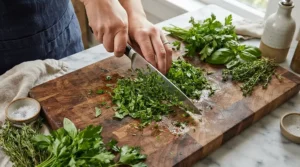
An ambidextrous handle is one that feels identical whichever hand holds it. In practice, that means a symmetrical cross-section, usually round or oval, with no ridge, hump, or notch pointing one way.
The Global G-2 is the purest example: a seamless steel cylinder with dimples, no orientation at all. The Victorinox Fibrox Pro 8-Inch and Mercer Culinary Millennia M22608 use symmetrical textured handles, with the Mercer Culinary Millennia M22608 adding a finger guard. The MAC MTH-80 and Tojiro DP Gyuto 210mm use classic Western-style handles that most users find neutral.
The wild card is the D-shaped handle. One retailer notes the standard Shun D-handle is designed for right-handed use, though some lefties find it comfortable anyway. The Shun Classic Left-Handed 8-Inch solves that by mirroring the contour.
A quick test: close your left hand around the handle and look for a ridge pressing awkwardly into your palm or fingers. If your thumb and forefinger settle naturally into a pinch grip at the blade and nothing digs in, you’ve found an ambidextrous handle that works for you. If you have small hands, favor slimmer handles over bulky ones, because a handle too big forces a weak grip.
Bevel Orientation: Which Face Gets the Edge, and Why You Should Care
Bevel orientation is simply which side of the blade carries the cutting angle. On a double-bevel knife, both do, so orientation stops mattering. On a single-bevel knife, it determines whether the blade cuts straight or veers.
Bite My Bun’s bevel guide explains that single-bevel knives come in left- and right-handed versions, with the ground side opposite for lefties. Another source describes the bevel as typically on the right side for right-handed users and the left side for left-handed users. A right-handed single bevel in a left hand tends to steer the cut off course.
For home cooks, bevel orientation comes down to three checks. First, confirm whether a knife is double or single bevel before buying. Second, if it’s single bevel, confirm in writing that it’s ground for the left hand, as with the Lefty’s Left Handed Chef Knife, and check listing photos. Third, understand that sharpening a single-bevel knife means working mostly one face, which takes practice.
Bevel orientation is the most common reason lefties return Japanese knives, because it’s easy to overlook in a listing. If the product page doesn’t state it clearly, ask the seller or choose a double-bevel alternative like the Tojiro DP Gyuto 210mm.
How to Choose a Left Handed Chef Knife for Lefty Home Cooks
Here’s a simple, ordered process for picking a left handed chef knife for lefty home cooks.
- Decide your budget. Under $30 gets you the Mercer Culinary Millennia M22608; $40–$65 gets you the Victorinox Fibrox Pro 8-Inch; $100 and up opens Japanese steel.
- Choose double bevel unless you have a reason not to. It works for either hand and is easier to sharpen.
- Test the handle against your grip. Pinch-grippers love the Global G-2; palm-grippers often prefer textured handles.
- Pick a length. Eight inches suits most cooks; seven and a half suits small boards and hands.
- Check weight. Under 6 ounces feels nimble; around 7 feels balanced; heavier powers through dense vegetables.
- Verify the edge symmetry when it arrives, as described above.
- Plan for upkeep. If you’ll never hand wash or hone, favor tougher, simpler steel.
Long-Term Cost & Maintenance: What Each Knife Really Costs You
A cheap knife that dulls fast costs more than a good one that holds an edge. Think in terms of cost per year, not sticker price.
| Knife | Upfront Range | Upkeep Needs | Value Verdict |
|---|---|---|---|
| Lefty’s Left Handed Chef Knife | Around $20 | Frequent honing, uncertain edge retention | Low risk, short horizon |
| Mercer Culinary Millennia M22608 | Under $30 | Easy sharpening, hand wash | Outstanding starter |
| Victorinox Fibrox Pro 8-Inch | $40–$65 | Easy sharpening, lifetime warranty | Best overall value |
| Tojiro DP Gyuto 210mm | $100–$140 | Whetstone sharpening, hand wash | Strong upgrade value |
| Global G-2 | $100–$200 | Hand wash, 15° sharpening | Good if grip fits |
| MAC MTH-80 | $150–$175 | Whetstone, careful use | Premium slicing value |
| Shun Classic Left-Handed 8-Inch | $190–$250 | Hand wash, fine edge care | Pricey but purpose-built |
The table points to a clear pattern. The Victorinox Fibrox Pro 8-Inch and Mercer Culinary Millennia M22608 have the lowest total cost of ownership for beginners, because they’re cheap to replace and easy to sharpen. The Tojiro DP Gyuto 210mm and MAC MTH-80 cost more upfront, but a good edge and a stone can last years. The Shun Classic Left-Handed 8-Inch is the most expensive, and the left-handed handle is the entire justification.
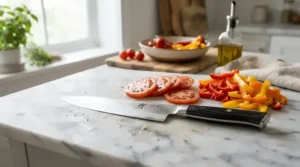
Your cutting board is part of the equation. The USDA’s cutting board guidance says solid wood, plastic, marble, glass, and pyroceramic boards are all options, recommends replacing boards once they develop hard-to-clean grooves, and advises separate boards for raw meat and ready-to-eat foods. For your knives, remember that glass and marble boards chip and dull edges quickly, so wood or plastic is kinder to every blade on this list.
FAQ: Left Handed Chef Knives for Lefty Home Cooks
❓ Is a left handed chef knife for lefty home cooks worth paying extra for?
❓ What blade length suits smaller left-handed hands?
❓ How often should a left-handed cook sharpen a chef knife?
❓ Where can I check current prices on left handed chef knives?
❓ Can left-handed cooks put a chef knife in the dishwasher?
Conclusion: Pick the Knife, Not the Label
The best left handed chef knife for lefty home cooks isn’t always labeled left-handed. For most people, a symmetrical double-bevel edge, a neutral handle, and a weight that feels right matter far more than any marketing. If you’re starting out, the Mercer Culinary Millennia M22608 and Victorinox Fibrox Pro 8-Inch are hard to beat. If you want a step up in sharpness, the Tojiro DP Gyuto 210mm, Global G-2, and MAC MTH-80 deliver real improvements in edge and finesse.
If you want the full mirror-image experience, the Shun Classic Left-Handed 8-Inch is the premium choice, and the Lefty’s Left Handed Chef Knife is the budget experiment. Just confirm the details before you buy.
Remember the three checks: verify bevel orientation, inspect the edge for symmetry, and test the handle against your grip. Do those, and you’ll skip the most common lefty frustrations. Pair your knife with a decent board, a honing habit, and a whetstone session now and then, and it will serve you for years.
✨ Ready to upgrade your prep? 🔪 Check current prices on your favorite pick, and enjoy cuts that finally go where you aim them. Your onions have been waiting long enough!
Recommended for You
- [Add your blog post link 1]
- [Add your blog post link 2]
- [Add your blog post link 3]
Disclaimer: This article contains affiliate links. As an Amazon Associate, I earn from qualifying purchases. If you purchase products through these links, we may earn a small commission at no additional cost to you.
✨ Found this helpful? Share it with your friends! 💬🤗
