
In This Article
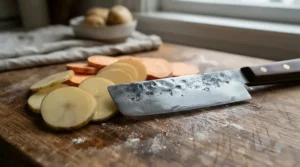
A hollow edge santoku for sticky potatoes is a Japanese-style, flat-profile kitchen knife with rows of shallow oval dimples ground into each side of the blade. Those scalloped hollows interrupt the flat contact between wet metal and starchy flesh, so slices fall away instead of gluing themselves to the steel.
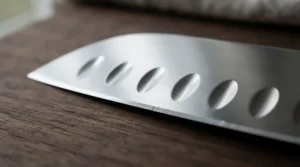
Anyone who has sliced a russet for gratin knows the scene. Slice one is fine, slice two is fine, and by slice six you’re peeling translucent potato wafers off the blade like wet wallpaper. It’s a small annoyance that wrecks your rhythm.
So do dimples fix it? Partly. America’s Test Kitchen’s breakdown of blade hollows reports that the hollows earn their keep on long slicing knives. The same testers found they weren’t needed on a top-rated santoku, because short santoku blades are already razor-thin. That’s the honest starting point, and it’s why this guide separates marketing from physics.
Below you’ll find seven real hollow edge and granton-style santokus, from budget stampings to forged and Damascus-clad blades. For each one you get what the specs mean on a cutting board, what reviewers keep saying, and who should skip the dimples entirely.
One note on method. This analysis is built from spec sheets, retailer review pages, and published testing, not from claimed hands-on use. Every price is a range as of the time of research, so check current price before buying.
Quick Comparison: Four Hollow Edge Santokus Worth Short-Listing
| Pick | Price range | Standout trait | Best For |
|---|---|---|---|
| Mercer Millennia | Around $20-$45 | Thin stamped blade, finger guard | Budget buyers, first-time santoku users |
| Victorinox Fibrox Pro | Around $35-$65 | Swiss-made, slip-resistant handle | Busy home cooks, heavy daily use |
| Zwilling Pro | Around $120-$190 | Curved bolster, ice-hardened blade | Cooks who like German heft |
| Shun Classic | Around $160-$190 | Damascus-clad VG-MAX core | Precision slicing, gift buyers |
Looking at the comparison above, the Mercer Millennia is the cheapest way to learn whether dimples suit your cutting style. The Victorinox Fibrox Pro adds a sturdier handle and a lifetime defect warranty for a modest step up. If you want a forged, heavier feel, the Zwilling Pro justifies its price jump with a bolster that guides your pinch grip. The Shun Classic is the pick when thin, precise slices matter more than rugged handling.
💬 Just one click — help others make better buying decisions too!😊
Top 7 Hollow Edge Santoku Knives for Sticky Potatoes: Expert Analysis
The seven knives below run from budget to premium. Ratings are snapshots from retailer pages, so numbers on Amazon may differ.
1. Mercer Millennia 7-Inch Santoku (M22707) — cheapest route to fewer stuck slices
The granton-style hollows are the headline here, and at this price the pitch is refreshingly modest. This is a one-piece stamped blade of high-carbon Japanese steel with a Santoprene handle, textured finger points, and a protective guard.
Stamped construction keeps the knife very light, about three ounces in one listing. That helps raw potato slide through with little wedging, though it gives you less forward weight for dense roots.
For weeknight roasting potatoes, thin and light is a feature, not a flaw. Listing data showed roughly 4.6 stars from several hundred reviews. One detailed reviewer loved it for slicing and dicing soft to firm vegetables, but found it less suited to heavy chopping and mincing. That reviewer called the dimples a compromise that makes a thin blade slightly less sticky, which is exactly the right expectation.
Pros:
- ✅ Very low cost of entry
- ✅ Thin blade glides through raw potatoes
- ✅ Textured handle with finger guard
Cons:
- ❌ Too light for heavy chopping or mincing
- ❌ Listed as not dishwasher safe
Expect around $20-$45. Verdict: the best low-risk experiment if you hand-wash.
2. Victorinox Fibrox Pro 7-Inch Granton Edge Santoku — workhorse built for daily abuse
This knife was designed for commercial kitchens and carries restaurant-supply credentials. It’s a Swiss-made stamped blade of high-carbon stainless, listed at 55-56 HRC, with a sheep’s-foot tip and a Fibrox handle that stays grippy when wet. It’s NSF-listed and backed by a lifetime warranty against defects.
That hardness sits at the softer end, so it responds quickly to a honing steel. The trade-off is more frequent touch-ups than a harder knife. Some supplier specs list the usable blade nearer 6.7 inches, so don’t expect a full seven.
Here’s the useful context. The same testers behind the earlier link favored the Victorinox 12-inch Fibrox Pro Granton Edge Slicing/Carving Knife for slicing. So the brand’s dimple design is respected, even if a short santoku needs it less. For potatoes, expect a modest but real improvement.
I couldn’t verify a representative set of reviews for this exact model, so treat its broad restaurant-supply availability as the main social proof.
Pros:
- ✅ Swiss-made with a lifetime defect warranty
- ✅ Slip-resistant handle works with wet hands
- ✅ Easy to hone and maintain
Cons:
- ❌ Stamped blade lacks a forged knife’s heft
- ❌ Utilitarian looks
Expect around $35-$65. Verdict: outstanding value for heavy use.
3. Henckels Forged Synergy 7-Inch Hollow Edge Santoku — forged feel without the premium bill
This is the cheapest forged option here. The maker lists German stainless steel at 55-58 HRC with a razor-edge finish and a matte black handle. Its own listing notes it’s made in China, which some buyers care about.
Forged construction usually means a bolster and better balance, and that steadies repetitive dicing. One reviewer on the maker’s page uses it in place of a traditional chef’s knife, calling it lighter and easier to control. The listing says it handles fruit, vegetables, meat, and cheese.
That versatility makes it a sensible all-rounder for households that slice potatoes on Sunday and cheese for guests on Friday. Its 4.7 rating comes from the brand’s own site, where reviews tend to skew positive, so weigh it accordingly.
Pros:
- ✅ Forged build with a bolster at a modest price
- ✅ Light enough for long prep sessions
- ✅ Handles vegetables, meat, and cheese
Cons:
- ❌ Made in China, a dealbreaker for some
- ❌ Mid-range hardness means regular honing
Expect around $45-$85. Verdict: the best “one knife for everything” in the budget-to-mid band.
4. Dalstrong Shogun Series 7-Inch Santoku — hardest steel and sharpest angle here
Dalstrong’s version of the dimples is branded “Rockhollow” divots. A 2026 retailer roundup lists AUS-10V Japanese steel at 62+ HRC and an edge angle of 8-12 degrees. Past marketplace listings have included a protective sheath.
Hardness this high means the edge lasts longer between sharpenings. A very acute angle slices raw potato with minimal wedging. The downside is that hard steel is less forgiving of twisting, prying, or frozen foods, and chips are more likely than on softer German steels.
The same roundup shows about 4.5 stars from roughly 1,200 reviews. I couldn’t read the underlying review text, so I can’t tell you what themes dominate. Choose this one if you’re comfortable with a whetstone and gentle handling.
Pros:
- ✅ Very high hardness for long edge retention
- ✅ Acute 8-12 degree edge angle
- ✅ Large review base (about 1,200)
Cons:
- ❌ Hard steel can chip if mishandled
- ❌ Maintenance suits whetstone users
Expect roughly $100-$140. Verdict: a premium edge at a mid-premium price, for careful cooks.
5. Zwilling Pro 7-Inch Hollow Edge Santoku — German comfort with an Asian-style angle
This is one of the better-reviewed knives in the group. The blade is ice-hardened FRIODUR steel, with a retailer listing of 57 HRC. It runs 7.09 inches, has a full tang with triple rivets, and weighs about 0.8 pounds. Slim and Rocking variants also exist.
The curved bolster is the standout. It lets you pinch-grip right behind the edge, which gives you precise steering through slippery potatoes. Reviewers on the maker’s site say the narrower Asian-style edge angle feels sharper than the same line’s chef’s knife.
One owner reported that veggies still stick, even though the hollow ground blade cuts easily. That’s honest feedback and consistent with the physics. Ratings of 4.9 from hundreds of reviews come from the brand’s own site, and one retailer snapshot ranked it among the top 60 Amazon santokus.
Pros:
- ✅ Curved bolster supports a secure pinch grip
- ✅ Ice-hardened steel holds a keen edge
- ✅ Standard, Slim, and Rocking options
Cons:
- ❌ Heavier than stamped rivals
- ❌ Some owners report occasional clinging
Expect around $120-$190. Verdict: the most balanced premium pick for German-style cooks.
6. Wüsthof Classic Ikon 7-Inch Hollow Edge Santoku — laser-honed edge at a 10-degree angle
This is a forged stainless blade with Wüsthof’s PEtec laser-guided edge process. The maker claims 20% sharper and twice the retention, which is marketing, not independent testing. Retailers list a 10-degree edge angle, a roughly 12.1-inch overall length, about five ounces, and a polymer handle with triple rivets. Hardness appears in the mid-to-high 50s HRC.
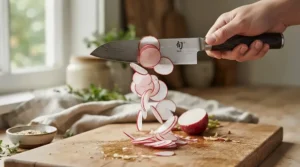
That narrow angle slices raw potato with little force, and retailer descriptions say the divots make potatoes release more easily. The cost is that thin edges ask for careful boards and honing.
One retailer page shows 4.8 stars from 16 reviews, with 94% recommending it. One reviewer uses it multiple times daily for chopping and dicing. That’s a small sample, so don’t over-read it.
Pros:
- ✅ Narrow 10-degree edge slices with little force
- ✅ Forged full-tang balance
- ✅ Hollows aid release on starchy foods
Cons:
- ❌ Premium price tag
- ❌ Small review base on the page I checked
Expect around $175-$250. Verdict: pay for the edge and balance, not the dimples.
7. Shun Classic 7-Inch Hollow Ground Santoku — Damascus-clad beauty built for precision
The Shun is handcrafted in Japan around a VG-MAX core, with 34 Damascus layers per side on the cladding. The D-shaped ebony PakkaWood handle sits best in a right hand, and the hollow-ground indentations are meant to cut friction.
A hard Japanese core takes a very fine edge, and the cladding protects it. A roundup lists the edge at roughly 16 degrees per side and notes it needs careful handling. For thin potato gratin slices or cucumbers, that precision is the draw.
One major retailer shows 4.3 stars from 22 reviews, a decent but modest signal. If you’re rough on knives or put them in the dishwasher, look elsewhere.
Pros:
- ✅ VG-MAX core takes a very fine edge
- ✅ Striking Damascus cladding
- ✅ Comfortable D-shaped handle for right-handers
Cons:
- ❌ Needs careful hand-washing and handling
- ❌ Pricey compared with German forged rivals
Expect around $160-$190. Verdict: the choice for thin-slice perfectionists.
| Product | Build | Steel / hardness | Price range | Review snapshot | Best For |
|---|---|---|---|---|---|
| Mercer Millennia | Stamped | High-carbon Japanese steel | $20-$45 | ~4.6 (several hundred) | Budget buyers |
| Victorinox Fibrox Pro | Stamped | 55-56 HRC listed | $35-$65 | Not verified | Heavy daily use |
| Henckels Forged Synergy | Forged | 55-58 HRC | $45-$85 | 4.7 (brand site) | All-round versatility |
| Dalstrong Shogun | Rockhollow divots | AUS-10V, 62+ HRC | $100-$140 | ~4.5 (~1,200) | Edge-retention fans |
| Zwilling Pro | Forged | 57 HRC listed | $120-$190 | 4.9 (brand site) | German heft |
| Wüsthof Classic Ikon | Forged | High-50s HRC | $175-$250 | 4.8 (16 reviews) | Precision cutters |
| Shun Classic | Damascus-clad | VG-MAX core | $160-$190 | 4.3 (22 reviews) | Thin slicing |
Reading across the table, price mostly buys weight, edge retention, and refinement, not dramatically better sticking performance. The dimples are conceptually similar from the Mercer Millennia to the Shun Classic. If sticky potatoes are your only problem, the Victorinox Fibrox Pro or Henckels Forged Synergy covers it at far lower cost. The Zwilling Pro and Wüsthof Classic Ikon make sense when you also want balance, longevity, and a keener edge.
✨ Ready to Stop the Stick?
🔍 Take your potato prep to the next level with these carefully selected knives. Click any highlighted product name to check current pricing and availability. These blades will help you create crisp gratins and neat, even slices your family will love!
Scalloped Dimples and Air Pockets on Blade: What’s Really Happening
Scalloped dimples: Granton vs. kullenschliff
The oval hollows are often called “Granton edges.” According to America’s Test Kitchen, the design was patented in 1928 by what is now the Granton Knives Co. in Sheffield, England. True Granton scalloped dimples alternate side to side and run through the cutting edge. Most imitators are shallower and sit higher on the blade.
Mental Floss explains that the German term “kullenschliff” describes hollows that stop short of the edge. Nearly every santoku in this guide uses that kullenschliff-style layout, even when the box says “Granton.”
Air pockets on blade: the sticking science
Wet food pressed flat against smooth steel clings through suction and surface tension. Air pockets on blade faces break that seal by letting air in behind the slice. Starchy potato is worse because released starch acts like glue, which is why dimples can help.
There’s a catch. Mental Floss notes that dimples generally need a slightly thicker blade, and thickness can raise cutting resistance. ATK also observes that the hollows make a blade thinner and lighter. Both can be true depending on the knife’s overall design.
The practical takeaway is simple. Scalloped dimples and air pockets on blade faces help most with long, smooth slicing strokes and least with fast chopping.
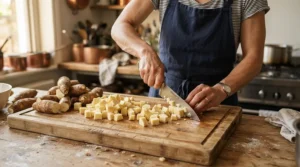
Santoku Knife That Prevents Food Sticking: Honest Expectations
Marketing says “prevents.” Reality says “reduces.” A buying guide from Joybuy cautions that the design isn’t a permanent non-stick effect and doesn’t replace good technique or the right board. A Canadian knife retailer’s wiki similarly notes that extremely moist or starchy ingredients may still adhere. One food writer even reported that sticking continued on a dimpled knife.
So what should you expect from a santoku knife that prevents food sticking? Expect fewer clingers, looser slices, and less peeling at the board. Don’t expect a Teflon effect.
Four factors matter more than dimple depth:
- Edge sharpness: a keen edge enters food cleanly, so fewer slices smear.
- Blade thinness: less wedging means less pressure squeezing slices against the steel.
- Cutting speed: faster, smoother strokes reduce clinging.
- Cleanliness: a quick wipe resets the blade.
If you want a santoku knife that prevents food sticking as well as physics allows, shop for sharpness and thinness first and treat the dimples as a bonus. That’s why the thin, narrow-angle Wüsthof Classic Ikon and Shun Classic compete well on slicing, while the featherweight Mercer Millennia wins on price.
Granton Edge Santoku Knife for Slicing Cheese: Does It Help?
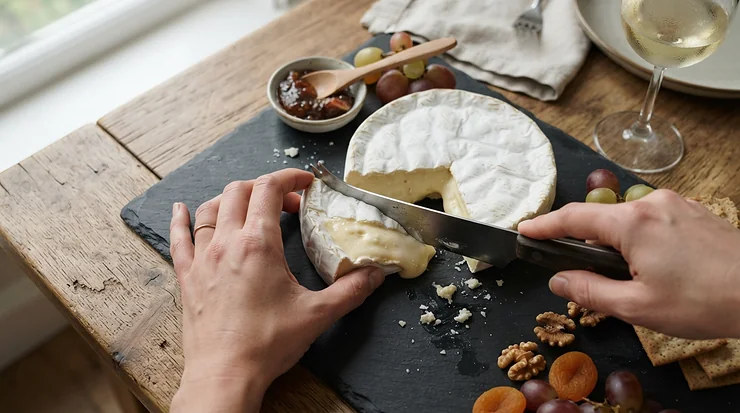
Cheese sticks for different reasons than potatoes. Fat and softness smear rather than glue, so results vary by cheese. A granton edge santoku knife for slicing cheese tends to work best on firm and semi-firm blocks like cheddar or gouda.
Support for the idea is anecdotal but consistent. A maker’s listing for the Henckels Forged Synergy says its hollow edge handles cheeses, and one reviewer of another dimpled santoku said it reduced drag on cheese and dense vegetables. A forum user with a granton slicer also reports good results on meats and cheeses.
Some practical limits apply:
- Crumbly cheeses will break rather than slice, dimples or not.
- Very soft cheeses still smear, so a quick dip in hot water and a wipe helps.
- Santoku blades are thin, so slice with the edge instead of prying or levering.
For a granton edge santoku knife for slicing cheese, the Henckels Forged Synergy is the sensible all-rounder. The Mercer Millennia is the cheapest way to try it, and the Shun Classic suits anyone who wants cheese slices as thin as paper.
Thin Slicing Release: A Step-by-Step Technique Guide for Starchy Spuds
Even the best hollow edge santoku for sticky potatoes needs good technique. Thin slicing release, meaning slices that drop cleanly off the blade, is half knife and half method.
- Stabilize the potato. Trim a thin slab from one side to make a flat base so it won’t roll.
- Use the claw grip. Curl your guiding fingers and let your knuckles act as a fence.
- Slice, don’t press-chop. A long forward-and-down stroke keeps the dimples engaged. Chopping straight down pins slices flat against the blade.
- Keep a steady rhythm. Faster, smoother strokes reduce clinging.
- Wipe the blade. A damp cloth between batches resets the surface.
- Rinse if the recipe allows. Cold water washes away surface starch that acts like glue. Tasting Table’s explainer on potato slicing covers why starch and smooth steel stick together and how divots interrupt it.
During the first 30 days, watch for two mistakes: twisting the blade to free stuck slices, and letting wet potatoes pile up on the board.
Real-World Scenarios: Matching a Hollow Edge Santoku to Your Kitchen
Scenario 1: the budget-conscious student. You cook three nights a week on a tight budget in a small apartment. The Mercer Millennia or Victorinox Fibrox Pro gives you a thin, easy-to-hone blade, and either one is cheap enough to replace.
Scenario 2: the family meal-prepper. You peel, slice, and roast potatoes most weekends for a household of four. The Henckels Forged Synergy brings forged balance at a modest price. If you can stretch your budget, the Zwilling Pro‘s curved bolster reduces hand fatigue across long prep sessions.
Scenario 3: the entertaining enthusiast. You host a few dinners a month and slice cheese boards, gratins, and cucumbers. The Shun Classic and Wüsthof Classic Ikon both deliver thin, precise slices, and both reward careful hand-washing.
Scenario 4: the whetstone hobbyist. You already sharpen your own knives and want the longest-lasting edge. The Dalstrong Shogun gives you very hard steel and a very acute angle, as long as you handle it gently.
How to Choose a Hollow Edge Santoku for Sticky Potatoes
- Decide your real problem. If you only fight sticking on potatoes and cucumbers, a budget pick is enough. Spending more should fix other needs too.
- Check blade thickness. Thinner blades wedge less, which matters more than dimple depth.
- Prefer a narrow edge angle. Angles around 10-16 degrees per side slice starchy food cleanly, but they ask for careful use.
- Match weight to your cutting style. Light stamped blades suit slicing, while heavier forged blades help with dicing and chopping.
- Test the handle fit. A curved bolster, D-shaped handle, or textured grip changes comfort more than most specs.
- Be honest about care. If you’ll use the dishwasher, favor tougher stamped blades.
- Plan sharpening. Know whether you’ll use a honing steel or a whetstone before buying very hard steel.
Hollow Edge Santoku vs Plain Santoku: Is the Upgrade Worth It?
| Feature | Hollow edge santoku | Plain-sided santoku |
|---|---|---|
| Sticking on wet or starchy foods | Fewer and looser clings | More suction on flat steel |
| Weight and thickness | Often thinner or lighter | Varies; some thicker |
| Sharpening | Dimples usually sit above the edge | Standard |
| Price | Slight premium on some models | Often a little lower |
| Best For | Potatoes, cucumbers, cheese, salmon | General chopping, mincing |
The table shows a modest but real advantage for wet, starchy slicing. ATK’s testers still preferred a plain santoku in their rankings, so the benefit is narrower than marketing suggests. If you slice potatoes weekly, dimples are worth a small premium. If you mostly mince and chop, put the money into steel and handle comfort instead.
Common Mistakes When Buying a Hollow Edge Santoku
- Assuming “hollow edge” means “non-stick.” The dimples reduce sticking but don’t eliminate it.
- Treating “Granton” as a guarantee. Most dimpled santokus use kullenschliff-style hollows that stop short of the edge.
- Buying on dimples instead of steel and fit. A mediocre blade with great hollows is still a mediocre blade.
- Ignoring hand size and grip style. Pinch-grippers love a bolster, while others prefer a flat spine.
- Using the wrong board. Hard glass or stone surfaces dull any edge quickly.
Features That Actually Matter (And Those That Don’t)
Matter most:
- Edge sharpness and angle. This drives clean slicing and release.
- Blade thickness. It controls how much food wedges against the steel.
- Handle fit and balance. These govern comfort over a long prep session.
Matter somewhat:
- Dimple size and spacing. Deeper hollows can help, but results depend on the whole knife.
- Warranty. The Victorinox Fibrox Pro lifetime defect cover is a useful reassurance.
Matter least:
- Damascus patterns. They look striking on the Shun Classic but don’t change slicing physics.
- Exact HRC numbers. A one- or two-point difference rarely shows up in home kitchens.
- Sheath or packaging extras. Nice, but secondary.
Long-Term Cost & Maintenance: Keeping Scalloped Dimples Clean and the Edge Keen
Think in cost per use, not sticker price. A knife in the low-$40s range used three times a week for five years works out to well under a few cents per use. A premium knife costs more upfront but may last longer if you maintain it properly.
Maintenance is simple:
- Hand-wash and towel-dry. Even models listed as dishwasher safe, like the Victorinox Fibrox Pro, are better off hand-washed. The Wüsthof Classic Ikon‘s maker specifically recommends hand-washing and immediate drying.
- Clean the scallops. Starch and residue collect in the dimples, so give them a gentle wipe.
- Hone regularly. Because the scalloped dimples on most santokus sit above the edge, you hone and sharpen as you would any knife.
- Pick the right board. Michigan State University Extension notes that wood and plastic boards are much kinder to blades than glass or stone.
Done well, even the budget Mercer Millennia stays keen far longer than neglect would allow.
FAQ
❓ Do hollow edge santoku knives really stop potatoes from sticking?
❓ What is the best hollow edge santoku for slicing cheese?
❓ Can you sharpen a granton edge santoku at home?
❓ Is a hollow edge santoku dishwasher safe?
❓ Are scalloped dimples worth paying extra for?
Conclusion
Sticky potatoes are a real annoyance, and a hollow edge santoku is a smart, modest fix. The honest picture is that dimples reduce clinging rather than prevent it. Testers like America’s Test Kitchen found them more useful on long slicers than on already-thin santokus, so the best results come from pairing dimples with a sharp, thin blade and a long slicing stroke.
If you want the quick shortlist: the Mercer Millennia is the budget experiment, the Victorinox Fibrox Pro is the rugged workhorse, and the Henckels Forged Synergy is the versatile mid-range pick. For premium balance, look at the Zwilling Pro, Wüsthof Classic Ikon, or Shun Classic. Cooks who sharpen their own knives might consider the Dalstrong Shogun. Match the knife to your cutting style and care habits, and you’ll spend less time peeling slices off steel.
Recommended for You
- [Add your blog post link 1]
- [Add your blog post link 2]
- [Add your blog post link 3]
Disclaimer: This article contains affiliate links. As an Amazon Associate, I earn from qualifying purchases. If you purchase products through these links, we may earn a small commission at no additional cost to you.
✨ Found this helpful? Share it with your friends! 💬🤗
